
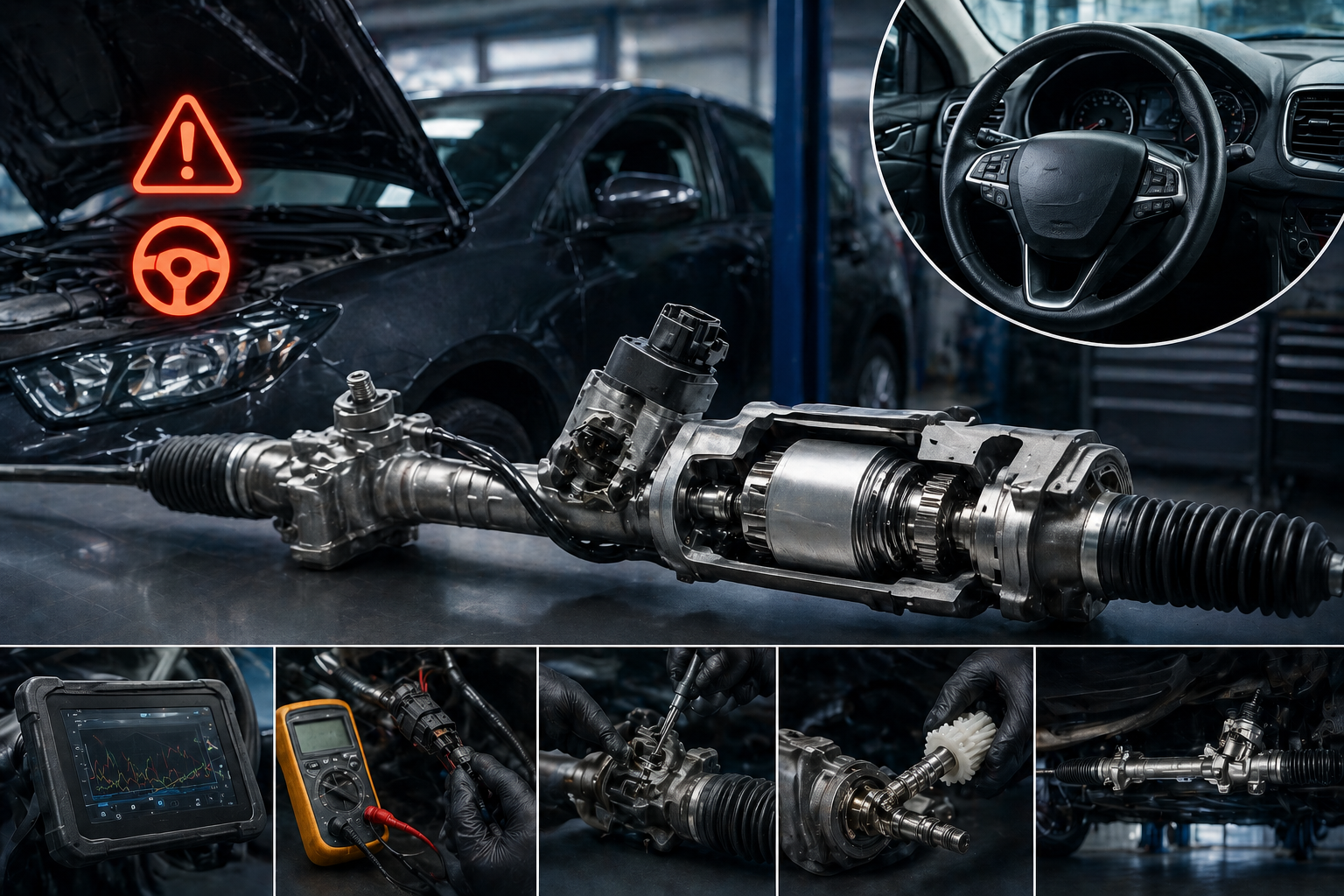
Gone are the days when diagnosing a failing steering rack meant looking for a puddle of red hydraulic fluid on the shop floor. Today, Electric Power Steering (EPS) rules the road. It’s great for saving fuel and enabling smart driving features, but when it breaks, you aren’t chasing leaks—you’re chasing electrical faults, bad grounds, and worn sensors.
If you are an automotive technician, a parts distributor, or a shop owner, understanding common EPS failures and how to pinpoint them without relying on guesswork is what keeps your customers happy and prevents costly comebacks.
Here is a practical breakdown of the most common electric power steering failures we see in the field, what causes them, and how to get them fixed.
The Basics: How Electric Power Steering Works
Before diving into diagnostics, let’s quickly recap the system. Instead of a hydraulic pump dragging on the engine, EPS uses an electric motor to help turn the wheels.
Itoperates in a loop:
- Torque & Angle Sensors measure how hard and how far the driver is turning the wheel.
- The ECU (Electronic Control Unit) takes that data, checks the car’s speed, and figures out how much help is needed.
- The Electric Motor pushes the rack to provide that assist.
Because EPS is a mix of heavy mechanical parts and sensitive electronics, failures can come from both sides.
5 Common EPS Failures We See in the Shop
1. The EPS Warning Light is On
This is usually the first sign of trouble. The driver gets a light on the dash, often followed by a stiff steering wheel.
- What’s happening: The ECU detected an error and threw the system into a fail-safe mode. This is usually caused by a failing torque sensor, a damaged wiring harness, or a software glitch.
- How to fix it: Don’t guess. Hook up a professional OBD-II scanner that can read ABS/EPS modules. Check for codes. Often, it’s just a corroded connector that needs cleaning. If a sensor is dead, it will need replacing and recalibrating.
2. Total or Intermittent Loss of Steering Assist
The steering suddenly feels like driving a tank, or the power assist cuts in and out randomly.
- What’s happening: This is often a thermal issue. If the EPS motor works too hard (like holding the wheel at full lock for too long), it overheats, and the ECU shuts it down to cool off. Alternatively, it could be an internal short in the motor winding or a mechanical bind inside the rack.
- How to fix it: Check the motor’s temperature and test the wiring for continuity. If the motor is fried, replacing the individual motor can be a headache.
Our advice: This is where dropping in a complete, remanufactured EPS gear from GL-Laida makes sense. We thoroughly test the motors on our racks so you don’t have to worry about an old, tired motor failing a week after the repair.
3. Vibrations, Clunking, or Noise During Steering
The driver feels a vibration through the wheel, or hears a grinding/clunking noise when turning.
- What’s happening: While EPS systems are electric, they still have mechanical guts. Worn rack bushings, bad bearings, or loose mounting bolts are usually the culprits.
- Shop Tip: Before condemning the expensive EPS rack, always double-check the tie rod ends, wheel alignment, and tire balance. Bad suspension parts often mimic EPS rack vibrations!
- How to fix it: Inspect the mechanical linkages. If the inner bearings or bushings of the rack are shot, a rack replacement is usually required to eliminate the noise permanently.
4. Erratic or “Jumpy” Steering
The steering feels overly sensitive, delayed, or pulls slightly to one side without driver input.
- What’s happening: The torque sensor is confused. This happens if the sensor loses its center calibration or if there is electrical interference (bad ground wire) messing with the sensor’s signal to the ECU.
- How to fix it: Inspect the ground straps on the vehicle. If the wiring is clean, use a scan tool to perform a “Torque Sensor Zero-Point Calibration.” If recalibration fails, the sensor is likely permanently damaged.
5. Heavy Steering ONLY at Low Speeds
Parking feels incredibly heavy, but driving on the highway feels fine.
- What’s happening: EPS systems draw a massive amount of electrical current at low speeds. If the vehicle’s battery is weak or the alternator is starting to fail, the EPS system simply isn’t getting enough juice to power the motor.
- How to fix it: Grab a multimeter. Test the battery voltage and alternator output under load. You’d be surprised how many “bad EPS racks” are actually just dying batteries.
Why Shops Prefer Remanufactured EPS Racks
Diagnosing and replacing small internal sensors or individual electric motors inside a dirty shop can be risky. If the seal isn’t perfect, moisture gets in, and the rack fails again.
For severe mechanical wear or motor failures, opting for remanufactured EPS racks is usually the most profitable and reliable route for shops and distributors.
At GL-Laida, we specialize in remanufacturing EPS steering gears the right way:
- We completely tear down the core and inspect every component.
- Worn bushings, bearings, and seals are thrown out and replaced.
- We bench-test the electric motors and recalibrate the torque sensors.
- The whole unit is reassembled and tested to meet OEM performance.
By supplying ready-to-install EPS gears, we help our B2B partners save time on the bench and eliminate customer comebacks.
Preventive Advice for Your Customers
Want to help your customers extend the life of their EPS system? Tell them to follow these simple rules:
- Keep the battery healthy: A weak electrical system kills EPS modules.
- Don’t hold the wheel at full lock: Holding it tight against the stop for more than a few seconds overheats the electric motor.
- Avoid deep water: Moisture is the worst enemy of the steering column’s electronics.
Wrapping Up
Electric power steering makes driving easier, but it requires a slightly different approach when things go wrong—think with your multimeter first, and your wrenches second.
If you’re a parts distributor, wholesaler, or repair facility looking for a reliable partner for steering components, we’ve got your back. To check out GL-Laida’s full catalog of rigorously tested, remanufactured EPS products, visit our homepage at www.gl-laida.com